· By Salman Habib Chaudhry · AI SEO · 8 min read
Is SEO Dead in 2026? (And What's Actually Replacing It)
AI Overviews, ChatGPT and Perplexity have everyone asking if SEO is over. The 2026 data on organic CTR, search volume, and AI citations — and what smart businesses do next.
Want results like this for your business?
Get a free growth audit →“Is SEO dead?” gets asked every time something big changes in search. It was asked when social media rose. When mobile search took over. When Google started answering questions directly in the search bar. SEO survived all of it. But this cycle feels different — and for good reason.
ChatGPT now reports roughly 800 million weekly active users (810 million as of November 2025, up from 700 million that September). Perplexity is routing around Google for a growing slice of informational queries. Google itself is inserting AI Overviews above organic results. The question is reasonable. Here’s a clear-eyed answer.
Key Takeaways
- SEO is not dead — Google still processes billions of searches per day and organic links remain the largest traffic channel on the open web.
- What changed is intent-dependent: AI Overviews compress click-through on simple informational queries, while commercial and local searches keep strong organic and Map Pack CTR.
- AI answer engines (ChatGPT at ~800M weekly users, Perplexity, AI Overviews) cite the same authoritative pages that already rank — so SEO is the entry fee for AI visibility, not a competing strategy.
- The real risk isn’t SEO dying; it’s losing top-of-funnel awareness if your brand never appears in AI answers.
- The winning move is overlapping investment: keep doing SEO and layer GEO (Generative Engine Optimization) on top of the same content foundation.
What has actually changed
Three things have shifted meaningfully in 2026:
1. AI Overviews eat some informational clicks. When someone searches “how long does SEO take”, Google sometimes generates an AI answer at the top of the page — pulling from multiple sources, not linking to any single one prominently. Simple, definitional, or how-to queries are the most affected. These were often low-converting traffic anyway, but they mattered for top-of-funnel exposure.
2. Buyers are using ChatGPT and Perplexity as research tools. Before a purchase decision, some buyers now ask an AI: “What are the best SEO agencies in Toronto?” or “Which CRM is best for a 20-person sales team?” If your brand isn’t appearing in those answers, you’re invisible to a growing audience segment.
3. Google’s algorithm is smarter. E-E-A-T (Experience, Expertise, Authoritativeness, Trustworthiness) signals matter more than ever. Generic, thin content is losing ground faster. Authoritative, well-structured, deeply useful content is winning more ground than before.
What hasn’t changed
- Google still processes 8+ billion searches per day
- Commercial-intent searches (“dentist Mississauga”, “buy enterprise CRM”, “marketing agency Toronto”) still produce traditional blue-link results with strong click-through rates
- Local searches still route through Google Maps and local packs — not AI
- Paid search still occupies the top of the page for high-CPC terms
- The majority of web traffic still comes from organic search
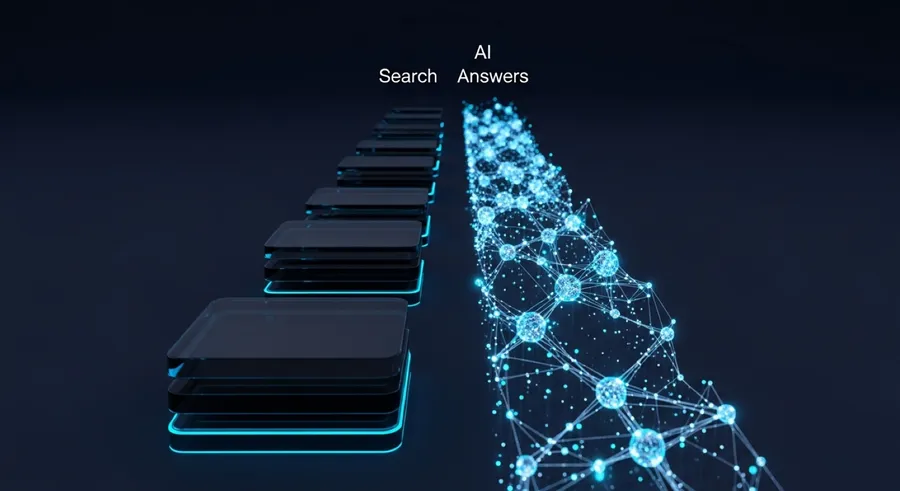
The “SEO is dead” narrative confuses two things: the decline of some informational-query traffic and the decline of organic search overall. The first is real and ongoing. The second has not happened.
The actual risk
The real risk isn’t that SEO dies. The risk is that businesses with no AI search presence lose a growing share of top-of-funnel awareness — the stage where buyers first become aware that they have a problem and start looking for solutions.
If a prospect asks ChatGPT “what’s the best way to grow organic traffic for a B2B SaaS company” and your agency isn’t mentioned, you’ve lost an awareness moment. That buyer may still end up finding you through a Google search later — but you had a chance to be the first name they heard, and you missed it.
Over time, that compounding absence erodes brand recall and shortens your path from “never heard of them” to “hired them.”
What the 2026 data actually shows
The argument that “SEO is dead” tends to lean on intuition rather than numbers. The numbers tell a more nuanced story.
Google’s own position is that organic search is still the largest traffic channel on the open web. In the company’s 2024 search update blog posts and ongoing AI Overviews coverage, Google has repeatedly emphasized that AI Overviews are designed to send traffic to sites — not replace them — and that organic links continue to appear under and alongside AI-generated answers. You can argue with the framing; the existence of those links and the click data behind them is harder to argue with.
Organic still dominates the traffic mix. SparkToro and Datos’ Zero-Click Search Study (2024 update) found that for every 1,000 US Google searches, roughly 374 still produce a click to the open web — meaning organic and paid links combined remain the dominant exit from a search. The share of zero-click searches did rise modestly, but most of that increase came from searches that were never going to drive web traffic anyway (weather, calculator, definitions).
AI Overviews coexist with organic clicks more than they replace them. Multiple 2025–2026 industry analyses (Search Engine Land’s AI Overview impact coverage, Search Engine Journal’s organic CTR reports) show that informational queries are seeing measurable CTR compression, while commercial and local queries are largely unaffected. The pattern is uneven by intent, not a uniform decline.
Search volume is still growing, not shrinking. Google has publicly stated that it continues to process more queries each year, not fewer, even as ChatGPT and Perplexity grow. The picture is “more search overall, distributed across more surfaces” — not “Google losing share at the headline level.”
AI assistants cite the same sites that rank organically. Rand Fishkin’s analysis of AI citation overlap with Google’s top 10 and HubSpot’s 2025 State of Marketing Report both point to the same conclusion: the URLs that ChatGPT, Perplexity, and Google AI Overviews cite most frequently are heavily concentrated among sites that already rank in traditional organic results. Investing in SEO is investing in AI citation eligibility — they are not separate plays.
The honest read: traditional SEO is shrinking in one specific slice (informational top-of-funnel) and stable-to-growing in every other slice. Calling that “dead” is a category error.
What smart businesses are doing
The winning move isn’t “SEO or AI” — it’s both, with overlapping investment rather than a split budget.
Traditional SEO still required:
- Service pages ranking for commercial-intent keywords
- Local SEO for geographic searches
- Technical health for crawlability and Core Web Vitals
- Link authority for domain trust
GEO (Generative Engine Optimization) layered on top:
- Structured content with clear, direct answers to questions AI systems cite
- Schema markup that helps AI parse your content accurately
- Entity reinforcement — being cited across the web as an authority on your topic
- Answer-layer formatting: concise summaries, clear H2s, FAQ sections
The good news: the best practices for GEO are also best practices for SEO. Well-structured, authoritative, deeply helpful content ranks in Google AND gets cited in AI answers. The investments overlap significantly.
The businesses most at risk
Not all businesses are equally affected by AI search shifts:
Most affected:
- Publishers and media companies monetizing informational content through display ads — AI Overviews eat their traffic directly
- Businesses whose main SEO traffic came from simple how-to and definitional queries
Less affected (but still need GEO investment):
- Local service businesses: plumbers, dentists, lawyers, contractors — AI doesn’t replace local pack results for these
- B2B companies with complex buying journeys — these buyers still research through multiple channels including traditional search
- E-commerce — product searches still go to Google, not ChatGPT
What to do in the next 90 days
Audit your current traffic mix. Which pages get traffic from informational queries? Which get commercial-intent traffic? The informational ones are more vulnerable to AI erosion. The commercial ones are more defensible.
Test your AI search visibility. Ask ChatGPT and Perplexity: “Who are the top [your service] companies in [your city/industry]?” Are you mentioned? If not, that’s a GEO gap to close.
Upgrade your content structure. Every major service page should have: a clear H1 that directly states what you do and for whom, a concise intro paragraph that summarizes your position, clear H2 sections, an FAQ section with direct answers. This structure ranks better in Google AND gets cited more in AI answers.
Don’t abandon link building. Domain authority is the common currency of both traditional SEO and AI search citation. Authoritative sites get cited in AI answers. Links build authority. The strategy remains the same.
SEO is not dead. But the search landscape has expanded. The businesses that will win in the next 2–3 years are the ones that claim their spot in both the traditional results and the AI answer layer — starting now, while most of their competitors are still debating whether this matters.
If you want the deeper plays in either lane, the SEO services in Toronto guide covers the traditional side at depth, LLMO explained and what is AEO cover the AI side, and the Toronto SEO consultant hiring guide covers what to look for if you’re outsourcing this. For the hard numbers behind the “is search dying” debate, our AI Search & GEO statistics for 2026 collect 30+ cited data points on AI Overviews reach, ChatGPT and Perplexity usage, and zero-click impact. Our SEO services page and AI SEO service cover scope and pricing.
Sources
- Google — The Keyword blog (search updates and AI Overviews) — accessed May 2026
- SparkToro & Datos — 2024 Zero-Click Search Study — accessed May 2026
- Search Engine Land — AI Overviews coverage — accessed May 2026
- Search Engine Journal — SEO category archive — accessed May 2026
- SparkToro — Rand Fishkin AI search analyses — accessed May 2026
- HubSpot — State of Marketing reports — accessed May 2026
- Exploding Topics — ChatGPT user statistics — accessed May 2026
- DemandSage — Google search statistics — accessed May 2026
Digital Estate Media provides AI SEO services that cover traditional SEO, GEO (Generative Engine Optimization), and LLMO (Large Language Model Optimization) for Ontario businesses. Get a free audit.
Want this done for you?
Tell us what you're trying to grow and we'll send back a concrete plan — no commitment.
Your free audit is on the way.
We'll reply within 24 business hours with your 3 quick wins, your top competitor gap, and a 90-day growth plan. Keep an eye on your inbox.